

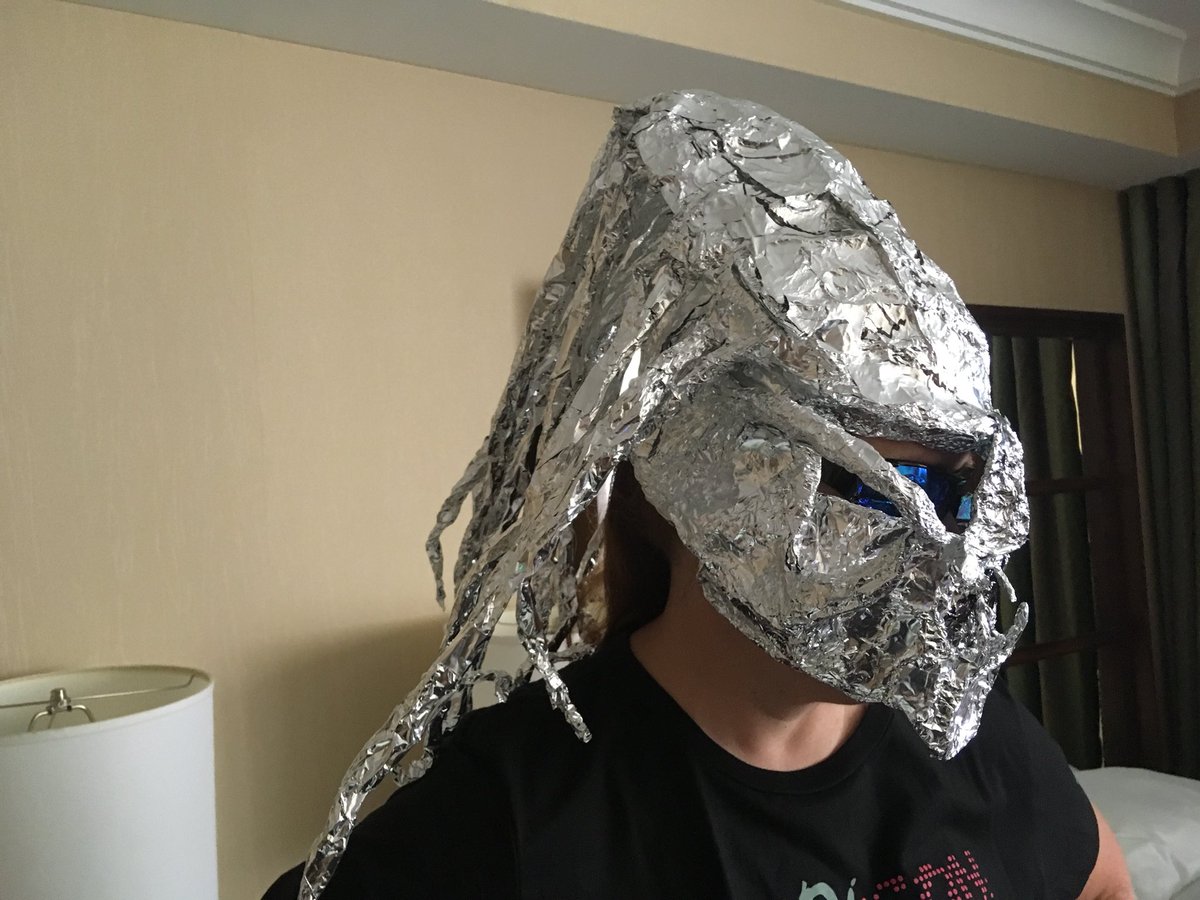
Individuals who are paranoid and have confidence in conspiracy theories often wear tin foil hats. Some individuals think that if they wear a tin foil hat, the federal government won't be in a position to tell them what things to think.
Aluminum foil, which is what these hats are constructed of, is known to block electromagnetic waves. Some people who have confidence in conspiracies think that tin foil hats will keep them safe from chemtrails, mind control, and being taken by aliens.
Paranoia
Paranoia is a mental illness which makes people feel like they can't trust anyone. It really is caused by things such as genetics, stress, suppressed feelings, and a past to be abused. It is also a side-effect of some drugs, like antipsychotics or drugs for nervousness. People who find themselves anxious might find it hard to trust a doctor or therapist, so they might not get help. They could even refuse to take their medicine or not want to. Psychotherapy, cognitive behavioral therapy, and group treatment are ways to treat anxiety.
Many people who believe in conspiracies wear tin foil hats because they think it'll protect them from mind control by the federal government, chemtrails, alien kidnapping, and other supernatural dangers. They think that tin foil protects their brains from radiofrequency (RF) and electromagnetic fields (EMF), that may cause diseases like cancer, Alzheimer's disease, and dementia.
Individuals who are anxious don't always realize they will have a problem and think their fears are reasonable. It's important to suggest to them support and urge them to visit a specialist for help. Nevertheless, you shouldn't tell them they're making things up or out of touch, because that can make them feel even more scared and suspicious. Try to calm them down instead, and offer to opt for them to their doctor or even to the SANE line.
Theories of a plot
People wear hats with aluminum foil linings because they think it stops electromagnetic energy and keeps the government from attempting to brainwash or read their minds. This view is based on the idea a box made of conducting material can stop electromagnetic fields and radio waves. That is called the "Faraday cage effect." make a tinfoil hat , alternatively, is mostly based on fake science and not on real scientific proof.
Conspiracy theories are a kind of epistemic need in which people believe important events must have been planned by someone. Douglas et al. (2019) found that they are more prevalent when there is doubt and when evidence-based theories are seen as not being good enough. People who have confidence in conspiracies are also more likely to not want the government to help them get vaccinated or protect their privacy (Jolley & Douglas, 2017).
Some people, especially those who find themselves part of the "truth movement," have started to wear tin foil hats to protect themselves from what they think will be the bad effects of technology. People act in this manner because they think that electromagnetic fields and radio waves could cause health problems like cancer and a number of other diseases. Occasionally, these people have used a range of electrical tools to get radiation that can not be seen. Tin foil can stop some electric waves from getting through, but it isn't as good as other materials.
Electromagnetic hypersensitivity (EHS) may be the inability to handle electromagnetic fields.
tinfoil hat who wear tin foil hats are neurotic and believe in conspiracy theories, but some of them actually have electromagnetic hypersensitivity (EHS), which is a real condition. This syndrome could cause headaches, body pain, tiredness, tingling in the hands or feet, dizziness, nausea, a burning feeling, and rapid heartbeat. Even though scientists think this problem is all in your brain, people with EHS have been able to get relief from their symptoms by way of a range of treatments.
People who have EHS often use copper wire protection to protect themselves from radiofrequency radiation (RFR) in order to treat their symptoms. They also say that you ought to stay away from items that produce RFR, like mobile phones, Wi-Fi routers, TVs, and electric tools. Some individuals even do not go out, stay in hotels, or see friends and family whose homes are full of electronics.
Despite the fact that mainstream science has mostly ignored this problem, you should remember that some studies have shown that folks with EHS have bad physical symptoms if they face certain environmental cues. Because of tinfoil hat , it is very important for scientists to create improved ways to find EHS signs and limit exposure to external factors that could cause them. Also, it's important for people with EHS to find the care they need from a doctor.
They are called the Illuminati.
The conspiracy idea concerning the Illuminati is probably the most popular delusional dreams of our time. People say that this hidden group runs the planet and has power over countries and celebrities. Some individuals say that the Illuminati is behind everything, from global warming to the NSA spying scandal. This idea has been around for a long time. It became popular for the first time in the 1960s, when the counter culture movement was going on. There were books, movies, and Television shows about it.

Adam Weishaupt, a disappointed Bavarian Jesuit, started the real Illuminati in 1776, but no-one knows what its goal is. Weishaupt thought that the church and the federal government were rendering it hard to believe freely. Ultimately, the group was deposit and stopped existing.
Many people today believe the Illuminati is still around. People who accept this notion often point to government leaders and celebs as part of the group. tinfoil hat think that the symbol of an eye in a triangle on the back of a US dollar bill is really a sign of the Illuminati. They believe that the occult is hidden in many places, like the way modern buildings are built and how money is manufactured.
Individuals who wear tin foil hats say that the hats keep electric fields and rays from hurting them. They also say that the hats protect their minds from being read or controlled. Even though there is no science behind the tin foil hat theory, it has become a stereotype and a catchphrase for anxiety and believing in conspiracy theories.